Play is a child’s natural form of expression. During play, children express their deepest emotions and beliefs they have built about themselves and the world.
They open themselves up and invite us to understand their world. But it is up to us to comprehend what is there to comprehend and meet their needs that they so clearly put out.
Any so-called “negative” behaviour is the child’s attempt to connect with the adults around them. It is the adults’ duty not to react to the exhibiting behaviour but to listen to what they are not saying.
We adults can reach out, talk about our difficulties, communicate our needs and get help. But children who have not yet developed the strength, clarity and vocabulary to speak about the difficulty they experienced need us to understand the unspoken and help them alleviate the difficulty they are facing.
This is exactly what Play Therapy does. A Play Therapist is trained to hold a safe space, build a trusting relationship, and allow the child to revisit the events or cause of difficulties at their own pace and find a resolution. The whole therapeutic process is led by the child and the therapist follows.
This work is shaped not just by training, but by years of being with children—understanding their inner worlds, holding space for their emotions, and supporting families through real, everyday challenges.
Children often express their struggles through behavior rather than words. Play therapy helps them process emotions like anger, anxiety, grief, and disconnection in a safe, developmentally appropriate way.
Children struggling with anger and aggression often have difficulty expressing their emotions in healthy ways. Play therapy provides a safe outlet for them to explore and manage these intense feelings, helping them develop better coping mechanisms.
Low confidence can hinder a child’s ability to engage with others and try new things. Through play therapy, children can build self-assurance as they successfully navigate challenges within a supportive and non-judgmental environment.
Children experiencing separation anxiety may feel overwhelming distress when apart from caregivers. Play therapy allows them to work through their fears in a safe space, fostering a sense of security and independence.
Life changes, such as moving to a new home or starting a new school, can be overwhelming for children. Play therapy helps them process these transitions, offering tools to adapt and thrive in new situations.
Impulsivity can lead to difficulties in school and social settings. Play therapy helps children learn to pause, reflect, and make more thoughtful decisions by practicing self-control in a playful, structured setting.
Children with attachment issues often struggle to form trusting relationships. Play therapy provides a nurturing environment where they can build connections, develop trust, and explore feelings related to attachment.
Low self-esteem can affect a child’s overall well-being and social interactions. In play therapy, children engage in activities that promote a positive self-image, helping them to recognize their strengths and worth.
Children who have experienced abuse may have difficulty expressing their trauma. Play therapy offers a safe and supportive space for them to process their experiences, helping them heal and regain a sense of control.
Children who exhibit compensatory inappropriate behaviors may be trying to cope with underlying emotional issues. Play therapy helps them address the root causes of these behaviors, guiding them toward healthier ways of expressing their needs and emotions.
Children who have experienced the death of a loved one or another significant loss may struggle to understand and express their grief. Play therapy offers a supportive space for them to explore their emotions and begin the healing process.
Children who have experienced traumatic events, such as natural disasters, accidents, or witnessing violence, may struggle with anxiety, fear, and confusion. Play therapy helps them process these events in a way that is developmentally appropriate and safe.
Children affected by divorce or ongoing family conflict may feel confused, guilty, or anxious. Play therapy provides a neutral space for them to express their feelings and learn to cope with changes in family dynamics.
Children with ADHD and those on the autism spectrum (ASD) may find it challenging to focus, manage impulses, connect with others, and navigate social interactions. Play therapy supports them in building attention, communication, social understanding, and emotional regulation in a safe and engaging way.
Children with selective mutism may find it difficult to speak in certain situations despite being able to speak in others. Play therapy can help them feel more comfortable and confident in expressing themselves in a non-threatening environment.


All our therapists are internationally-certified and supervised by leading play-based child well-being organizations.
Amrit Anandh works closely with children and parents to understand the emotional roots of behaviour and support meaningful, lasting change through play therapy, attachment, and deep emotional attunement.
Member of Play Therapy UK
Founder of TrustTheChild Montessori School.
Years of hands-on experience with children
Supports parents in building stronger, more connected relationships with their children
Years of hands-on experience with children
Starting something new for your child can bring up many questions. Here are some of the most common concerns parents have, answered with care and clarity.
If your child is showing ongoing emotional or behavioural changes—such as frequent meltdowns, withdrawal, anxiety, aggression, or difficulty adjusting to situations—it may be a sign they need deeper support.
Children express themselves through play rather than words. In sessions, they use toys, art, sand, and movement to communicate feelings, process experiences, and work through challenges in a safe space.
No. Play therapy is fully child-led. Your child is not expected to explain or verbalise anything. Expression and resolution happens naturally at a subconscious level through play. Once the trust is established, especially older children, tend to open up about their difficulties. But it's never expected or forced.
The duration varies for each child. Some children need shorter-term support, while others benefit from a longer process. It depends on your child’s unique needs, experiences, and pace.
Play therapy can support children with anxiety, anger, low confidence, separation difficulties, grief, trauma, social challenges, impulsiveness, and emotional regulation difficulties.
Yes, but not in a detailed manner. You will receive general insights, themes, and guidance, rather than detailed disclosures of everything your child expresses.
Yes. Confidentiality is an important part of building trust. What your child expresses in sessions is respected and kept private, except in situations where there are safety concerns. Both the parent and therapist will sign a confidentiality and consent form before the sessions start.
This is common, especially in the beginning. Children may take time to feel comfortable in a new space. The process is gentle and paced to help them feel safe rather than pressured. Being truthful about the process helps children accept it easier rather than trying to manipulate them into coming.
As children begin to feel safer and more regulated internally, you may notice gradual changes in their behaviour, emotional expression, and ability to cope with challenges at school, home and other social settings.
Your role is important. Being emotionally available, patient, and open to receiving guidance can help reinforce the work happening in therapy and strengthen your relationship with your child.
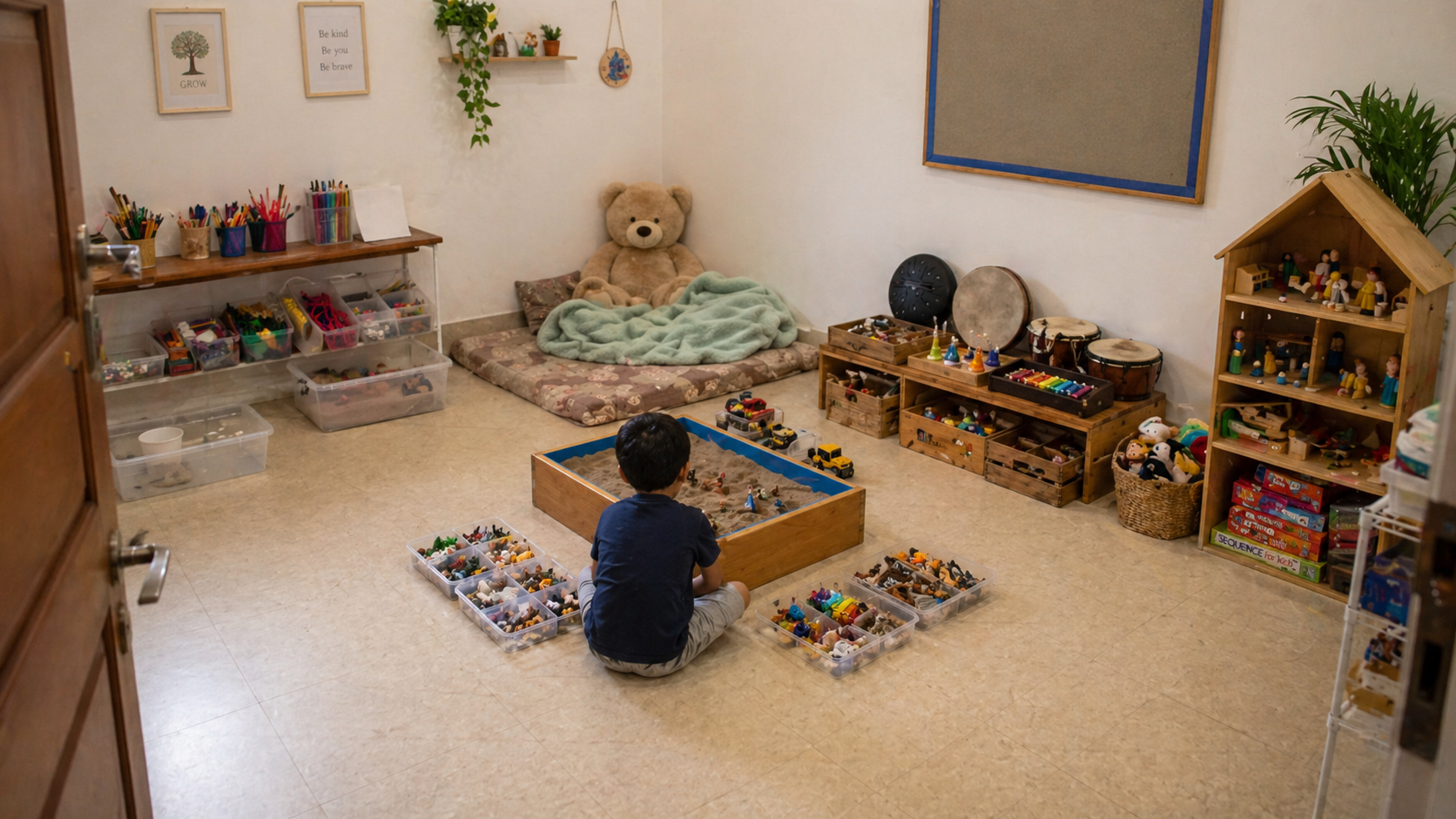
The Play Therapy toolkit is a carefully curated collection of therapeutic tools and resources designed to help children express their emotions, process experiences, and resolve psychological challenges through play. Play therapy leverages the natural medium of play, which is how children naturally explore their world, express themselves, and learn about relationships.
The toolkit typically includes items like art supplies, puppets, sand trays, therapeutic games, and sensory toys, each serving a unique purpose in facilitating emotional expression, problem-solving, and behavioral change. By using these tools in a safe and supportive environment, therapists can help children articulate their thoughts and feelings, develop coping strategies, and work through difficult emotions or traumas in a way that feels natural and engaging to them.
We came in feeling quite worried. Our child struggled with intense social anxiety, rarely spoke outside of home, and would become very distressed when things didn’t go perfectly. Even small situations could feel overwhelming.
Over time, we began to notice subtle but meaningful changes. There was more ease in social situations, a willingness to try without needing everything to be “just right,” and moments of spontaneous expression that we hadn’t seen before. Communication has slowly opened up, not in a forced way, but in a way that feels natural to them.
What stood out for us was how gently this process unfolded. There was no pressure on our child to change, yet something shifted from within. As parents, we also felt supported in understanding what our child might be going through beneath the surface.
We’re grateful for the space that was created—for both our child and for us.
Mother of 8yo girl
We reached out because our child found changes in routine very hard. Even small delays could lead to intense anxiety, and when things didn’t go as expected, it often resulted in big meltdowns. Socially too, they struggled—finding it difficult to form and maintain friendships.
Over time, we began to see a gentle shift. There was more flexibility when plans changed, less distress around delays, and a growing ability to stay with situations that would have earlier felt overwhelming. Socially, we noticed more ease—small steps towards connecting, engaging, and staying in interactions.
What felt most reassuring was that this change didn’t come from pressure, but from our child feeling safer within themselves. As parents, we also began to understand their inner experience better, which helped us respond differently at home.
The progress has been gradual, but deeply meaningful.
Mother of 10yo boy

Reaching out is often the first step toward understanding and getting the support you deserve. I look forward to hearing from you and understanding how I can serve you and your child.