Raising Resilient Children Through Regulation, Relationship, and Connection
Most parenting advice focuses on fixing your child’s behaviour. Reward charts, time-outs, consequences — they treat the symptoms, not the source.
But what if the real key to raising a resilient, emotionally secure child isn’t about controlling behaviour at all?
Relational parenting is a deeper approach. It starts with you — the parent — learning to stay regulated, connected, and intentional. When you change how you show up, everything changes for your child.
The Relational Parenting Framework is built on six practical pillars — two for the parent, two for the relationship, and two for the child. These pillars bring the framework to life in everyday parenting.
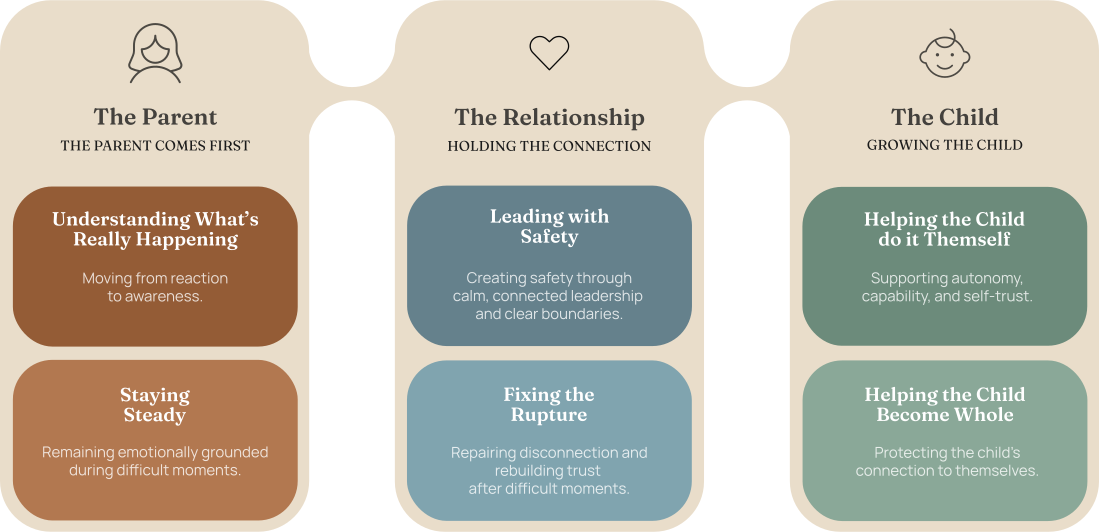

Parenting begins within. This framework helps you slow down, notice your own patterns, and respond with awareness instead of reaction. It is about building inner stability, not external control.
The relationship is the space where everything unfolds. When safety, trust, and connection deepen, cooperation follows naturally. This is not about managing behavior, but nurturing a living, evolving bond.
Every child is already wired for growth. When met with presence and understanding, the child moves toward regulation, confidence, and self-expression—without force, fear, or fixing.
Many difficult parenting moments follow a simple, often unseen pattern. What begins as a small situation can quickly escalate when something shifts within the parent and the relationship. The 3Ds — Dysregulation, Disconnection, and Distress — help us understand what is happening beneath the surface, so we can respond with greater awareness instead of reacting automatically.
When the parent becomes overwhelmed, reactive, or emotionally flooded. This is often the starting point where responses become less intentional.
As the parent’s state shifts, the relationship momentarily loses its sense of safety. The child may feel unseen, unheard, or pushed away.
The child expresses this disconnection through behaviour — tantrums, defiance, withdrawal, or emotional outbursts. What we see as behaviour is often a signal of distress.
In difficult parenting moments, it helps to have a simple way to find your way back. The 3Rs — Regulation, Reconnection, and Resilience — offer a clear and practical path forward. By first steadying yourself, then restoring connection, you create the conditions in which your child can settle, learn, and grow.
Pause and steady yourself before responding. Notice your tone, your body, and your emotions. When the parent becomes regulated, the moment begins to settle.
Restore safety in the relationship through your tone, presence, and connection. When disconnection happens, repair it by coming back together and helping the child feel seen and secure again.
Over time, the child develops emotional strength and independence. Resilience grows within a safe and connected relationship.
It’s not about raising perfect children. It’s about raising whole children.
A child who feels safe to express their full range of emotions.
A child who maintains a deep, lasting bond with their parents.
A child who trusts themselves to navigate the world.
A child who can bounce back from setbacks with inner strength.
Amrit Anandh’s work sits at the intersection of child development, emotional regulation, and relational repair. With experience working directly with children in Montessori environments, play therapy settings, and alongside parents navigating the toughest moments of family life, Amrit developed the Relational Parenting Framework to bridge the gap between academic research and the lived reality of parenting.
The framework was born from a simple observation: when parents learn to regulate themselves first, everything else follows — connection deepens, boundaries hold, and children flourish.
Founder of TrustTheChild Montessori School
Member of Play Therapy UK
Years of hands-on experience with children
Proven success transforming mother-child relationships
Years of hands-on experience with children
A comprehensive guide to transforming your parenting through regulation, relationship, and resilience.

Reaching out is often the first step toward understanding and getting the support you deserve. I look forward to hearing from you and understanding how I can serve you and your child.